
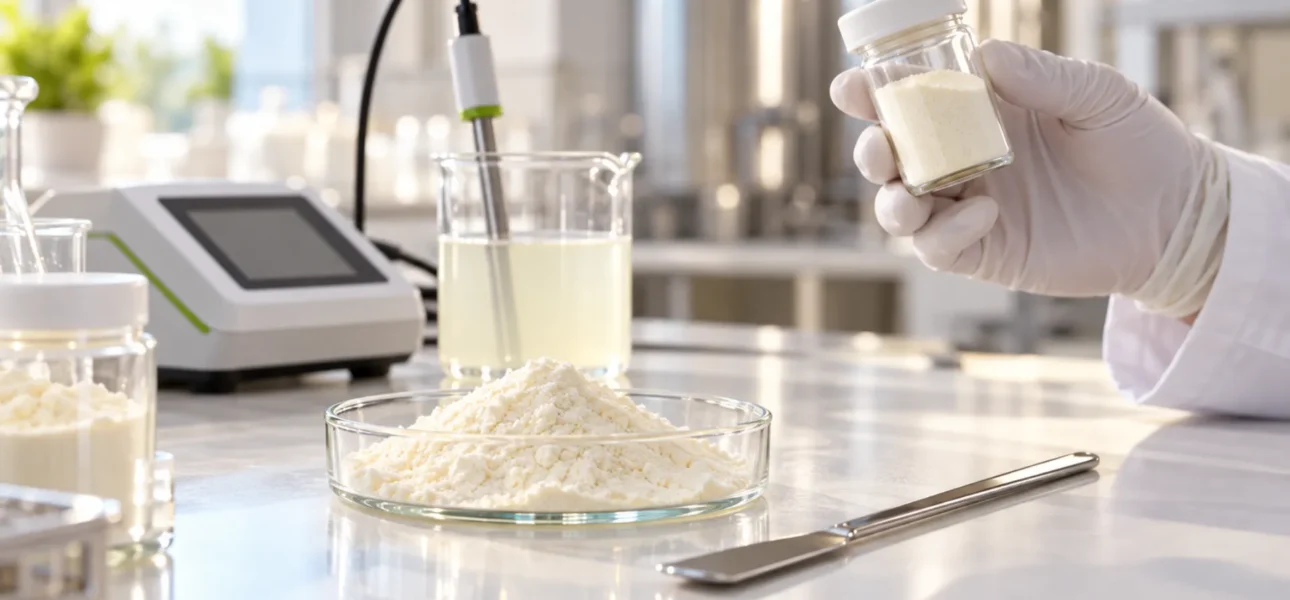
Demineralized whey powder is a dairy ingredient selected when a formulation requires whey-derived solids with a reduced mineral content. For food manufacturers, understanding its specification is essential to choosing the right product.
One of the most important distinctions is the difference between the demineralization level and the mineral content remaining in the finished powder. These figures describe different things and should not be used interchangeably.
This guide explains the terminology, compares demineralized whey powder with sweet whey powder and outlines the information buyers should review before purchasing.
What Is Demineralized Whey Powder?
Demineralized whey, also called reduced-minerals whey, is obtained by removing a portion of the minerals from whey. The resulting ingredient is available in powder form for use in food manufacturing. The U.S. Dairy Export Council describes it as an option where lower mineral or ash content is desired. thinkusadairy.org
The product name does not provide a complete specification. Two ingredients described as demineralized whey powder may have different composition limits and performance characteristics.
Buyers should therefore assess the current technical data sheet alongside their application requirements.
What Does the Demineralization Level Mean?
A demineralization percentage generally describes the extent of mineral removal relative to the starting whey, according to the supplier’s specified calculation basis.
For example, a product described as 70% demineralized generally indicates a nominal reduction of approximately 70% in the original mineral content. It does not mean that:
- The finished powder contains 70% minerals.
- The product contains 70% protein.
- The powder is 70% lactose-free.
- All individual minerals have necessarily been reduced by the same proportion.
The supplier should confirm the precise meaning of the declared level, its calculation basis and the specification of the finished product.
Demineralization Level and Final Ash Content Are Different
The demineralization level describes a reduction. Final ash content is a separate analytical specification used when assessing the resulting ingredient.
A buyer should request both pieces of information rather than trying to calculate the finished powder’s ash content from its grade name alone. The starting material, processing conditions and reporting basis all matter.
For procurement purposes, a clearly defined final specification is more useful than relying solely on a percentage in the product title.
How Is Demineralized Whey Produced?
Mineral reduction can involve separation technologies such as ion exchange, diafiltration or electrodialysis. The U.S. Dairy Export Council lists these among the techniques used for demineralized whey production. thinkusadairy.org
These are general industry methods. The process used for a particular product should be confirmed with its manufacturer.
Understanding the production method can support technical discussions, but purchasing decisions should ultimately consider the finished ingredient’s specification and its suitability for the intended formulation.
Demineralized Whey Powder vs. Sweet Whey Powder
Both ingredients originate from whey, but they should not be treated as identical products.
| Consideration | Sweet whey powder | Demineralized whey powder |
|---|---|---|
| Main distinction | Dried sweet whey ingredient | Whey ingredient with a portion of its minerals removed |
| Mineral reduction | Not defined by a demineralization grade | Declared reduction level should be confirmed |
| Purchasing focus | Complete composition and application suitability | Reduction level, final mineral specification and application suitability |
| Recipe substitution | Requires formulation assessment | Requires formulation assessment |
The choice should follow the requirements of the finished product. A higher demineralization level is not automatically the best option for every application.
Likewise, changing from sweet whey powder to a demineralized product should be evaluated through a specification comparison and appropriate production trials.
For an introduction to the related ingredient, read Sweet Whey Powder: Properties and Food Applications.
Where Can Demineralized Whey Powder Be Used?
Industry applications include bakery, confectionery, dairy and certain nutritional formulations. Suitability depends on the selected grade and the requirements of the finished product. thinkusadairy.org
Bakery and Confectionery
Manufacturers may consider demineralized whey powder where the mineral specification is relevant to their recipe or sensory targets.
Ingredient selection should account for the complete formulation, including other sources of dairy solids. Product trials should establish whether the selected grade delivers the required results.
Dairy-Based Formulations
For dairy-based products, buyers should consider how the ingredient fits into the overall composition and processing conditions.
The appropriate choice depends on technical requirements rather than the product category alone. A specification accepted for one recipe should not automatically be transferred to another.
Specialized Applications
Specialized formulations may require additional compositional, microbiological and documentation criteria.
A general product description does not establish suitability for a specialized application. Buyers should communicate those requirements explicitly and obtain confirmation for the particular grade being considered.
Which Specifications Should Buyers Review?
A purchasing discussion should cover more than the declared demineralization level.
| Parameter | What to clarify |
|---|---|
| Demineralization level | Declared grade and calculation basis |
| Ash and mineral specifications | Finished-product limits and any required individual mineral values |
| Protein and lactose | Composition relevant to the intended formulation |
| Moisture and fat | Agreed limits in the current technical specification |
| Sensory characteristics | Appearance, flavour and odour requirements |
| Microbiological criteria | Applicable limits and supporting documentation |
| Processing behaviour | Mixing and performance under the buyer’s production conditions |
| Packaging and storage | Pack size, handling instructions, shelf life and storage conditions |
Where batch-specific results are required, buyers should also discuss the availability and scope of a Certificate of Analysis.
Product specifications and batch analysis documents serve related but different purposes. The specification defines agreed requirements; batch documentation reports the results provided for a particular lot.
Preparing a Product Enquiry
A detailed enquiry helps the supplier identify the relevant product and respond efficiently.
Include:
- The intended food application.
- The required demineralization level.
- Any ash or individual mineral limits.
- Other essential composition requirements.
- Estimated order quantity and purchasing frequency.
- Delivery destination and documentation needs.
If the required grade is not yet clear, sharing the formulation objectives can provide a useful starting point for a technical discussion.
Frequently Asked Questions
Does 70% demineralized mean 70% protein?
No. Demineralization refers to mineral reduction, not protein concentration. Protein content must be checked separately in the product specification.
Is demineralized whey powder mineral-free?
No. The term describes a product from which a portion of the minerals has been removed. The remaining content depends on the selected grade.
Does demineralized mean lactose-free?
No. Mineral reduction and lactose reduction are different characteristics. Buyers should review the declared lactose content separately.
Can different grades be substituted directly?
A direct substitution should not be assumed. Compare specifications and evaluate the proposed ingredient in the actual formulation and process.
Discuss Your Demineralized Whey Powder Requirements
KEMPO Food includes Demineralized Whey Powder in its dairy ingredient portfolio.
Share your application, required grade, technical specifications and delivery destination with our team to discuss the appropriate product and supply requirements.
