
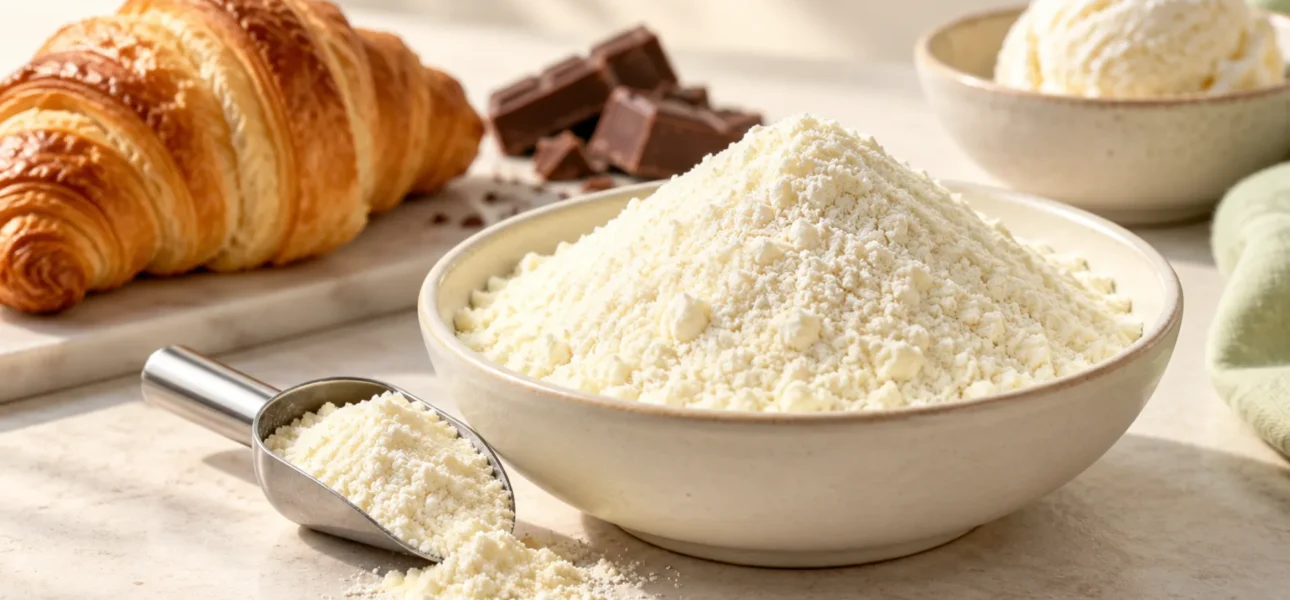
Sweet whey powder is a dairy ingredient used in a wide range of industrial food formulations. From bakery products and confectionery to ice cream and dairy desserts, it provides a practical way to incorporate whey-derived dairy solids into production.
Choosing the right ingredient requires more than a product name. Its composition, sensory characteristics, processing behaviour and packaging should all be considered alongside the requirements of the finished food.
This guide explains what sweet whey powder is, where it is used and what food manufacturers should review before purchasing.
What Is Sweet Whey Powder?
Sweet whey powder is produced by drying liquid sweet whey obtained during cheese production. Removing water creates a powdered ingredient containing whey constituents, including lactose, protein and minerals. The U.S. Dairy Export Council identifies sweet whey powder as a source of dairy solids for bakery, confectionery, snacks and other food products. thinkusadairy.org
KEMPO Food’s Sweet Whey Powder is described in its product information as being produced from whey derived from fresh, pasteurized milk during cheese-making. It has a creamy-white appearance, a naturally sweet taste and a pleasant creamy aroma.
For manufacturers, these characteristics make it an ingredient worth evaluating when developing or adjusting dairy-containing recipes.
Key Properties to Consider
The suitability of sweet whey powder depends on its specification and how it performs within a particular formulation. Buyers should assess both measurable composition and practical processing requirements.
Composition
Protein, lactose, moisture, fat and ash are important purchasing parameters. Each provides information about the ingredient, but no single figure determines whether it is suitable for a finished product.
For example, a formulation developed around a particular dairy-solids balance should be assessed using the complete ingredient specification rather than protein content alone.
Appearance and Flavour
Colour, aroma and taste should be consistent with the intended application. A dairy ingredient suitable for one recipe may still require trials in another, especially where a delicate flavour profile is important.
Dispersion and Processing Behaviour
Mixing conditions, temperature and the other ingredients in a recipe can influence how a powder behaves during production. Manufacturers should therefore evaluate the selected product under their own processing conditions.
Where Is Sweet Whey Powder Used?
KEMPO Food’s product information lists bakery, confectionery, ice cream and dairy desserts among the applications for Sweet Whey Powder. The role it plays will vary according to the recipe and production process.
Bakery Products
Sweet whey powder can be evaluated in bread, biscuits, cakes and other baked products where dairy solids form part of the formulation.
It can contribute to colour development during baking, although the result depends on the recipe and processing conditions. Trials should assess the finished product’s appearance, flavour and overall performance. thinkusadairy.org
Manufacturers should also review whether changes to the dairy ingredient require adjustments to water addition or other components of the recipe.
Confectionery
Confectionery applications may include chocolate-containing products, fillings and other dairy-based formulations.
Sweet whey powder should be assessed in relation to the desired flavour, texture and solids balance. Its use in one confectionery recipe does not establish a universal inclusion rate for other products.
Ice Cream
In ice cream development, sweet whey powder can be considered as part of the dairy ingredient system. A dairy ingredient manufacturer, Agropur, identifies ice cream among its sweet whey powder applications. Agropur Ingredients
The appropriate quantity should be established through formulation work and product trials, taking the complete recipe into account.
Dairy Desserts
Dairy desserts are another application listed in KEMPO Food’s Sweet Whey Powder information.
For these products, manufacturers should evaluate compatibility with the intended flavour profile, mixing process and finished-product requirements. Reviewing the ingredient specification before trials helps establish a clear starting point.
KEMPO Food Sweet Whey Powder: Selected Specifications
The following values are taken from the Sweet Whey Powder information supplied for KEMPO Food. They relate specifically to this product and should not be applied to the company’s other whey or milk powder products.
| Parameter | Supplied specification |
|---|---|
| Colour | Creamy white |
| Flavour | Sweet, without foreign flavours or odours |
| Protein | Minimum 11% |
| Moisture | Maximum 2.5% |
| Fat | Maximum 1.5% |
| Lactose | Minimum 65% |
Buyers should request the current technical specification and clarify any additional requirements before placing an order. Where batch-specific documentation is needed, this should also be discussed during the enquiry process.
Packaging and Storage Considerations
KEMPO Food’s supplied Sweet Whey Powder information specifies a 25 kg net weight in triple-layer kraft bags with an inner polyethylene liner and a double-seam closure.
Before ordering, buyers should confirm:
- The packaging specification for the selected product.
- Pallet configuration and shipment quantity.
- Required delivery destination.
- Recommended storage conditions and shelf life.
- Any documentation needed for receiving and handling.
Storage instructions should come from the current supplier documentation. General industry guidance should not replace the instructions provided for the particular product being purchased.
Choosing Sweet Whey Powder for Your Production
A useful product enquiry connects the ingredient specification with the actual manufacturing requirement.
Start by identifying the finished product and the intended role of the dairy ingredient. Then share the relevant technical requirements, estimated order volume and delivery destination.
Laboratory or pilot-scale trials can help determine whether the selected ingredient performs as required before it is introduced into routine production.
KEMPO Food combines manufacturing operations in Türkiye with international export experience. Its team can discuss product specifications and supply requirements with food manufacturers, importers and distributors.
Frequently Asked Questions
Is sweet whey powder the same as high-protein whey powder?
They should not be treated as interchangeable. Review the protein content and complete technical specification of each product before selecting an ingredient.
Can sweet whey powder replace milk powder?
A direct replacement should not be assumed. Any substitution requires a comparison of the ingredients and assessment of its effect on the complete formulation.
What is the packaging size of KEMPO Food’s Sweet Whey Powder?
The supplied product information specifies 25 kg net bags. Confirm current packaging details when requesting a quotation.
What information should I include in an enquiry?
Include the product name, application, technical requirements, estimated quantity and delivery destination. This helps the supplier respond with relevant information.
Discuss Your Sweet Whey Powder Requirements
Looking for sweet whey powder for your next formulation or an existing production process?
Contact KEMPO Food to request current product specifications and discuss your quantity, packaging and delivery requirements.
